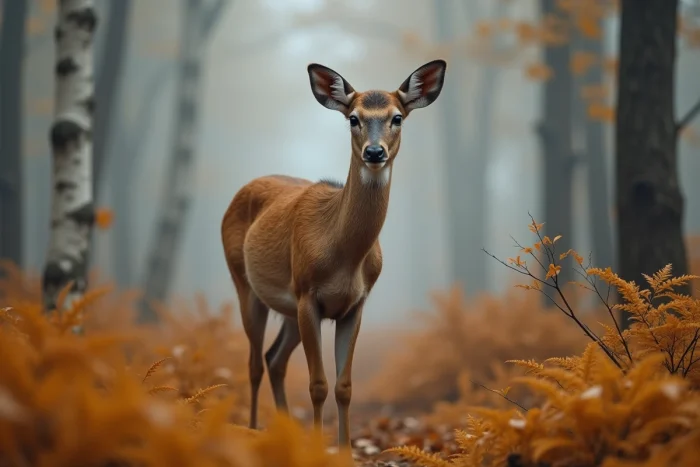
The doe occupies a unique place in the symbolic bestiary. While the stag represents solar power and royalty, the doe carries a symbolic weight related to receptivity, listening to subtle signals, and a form of sensory intelligence that several traditions have precisely codified. Understanding the significance of seeing a doe requires moving beyond the decorative register to enter a more structured framework of interpretation.
Ethological reading of an encounter with a doe
A doe that allows itself to be observed from a short distance is not an insignificant event ecologically. Deer populations in mainland France have experienced continuous growth over several decades, with high densities in many forested areas. The French Office for Biodiversity documents this trend, noting a more recent stabilization without a return to previous levels.
The fragmentation of forest habitats, combined with human pressure (roads, urbanization, recreational activities in forests), pushes does toward edges and peri-urban areas. Seeing a doe near a dwelling signals an imbalance in the natural environment, not just a poetic moment. To delve deeper into the meaning of seeing a doe, it is useful to cross this ecological reading with symbolic frameworks.
This ethological framing alters the symbolic reading. A doe that appears “by surprise” during a walk also reflects a lack of tranquility in its original habitat. Road collisions, pressure on crops, retreat of refuge areas: the encounter carries an ecological message that purely spiritual frameworks ignore.
Symbolism of the doe in Celtic and Greco-Roman traditions
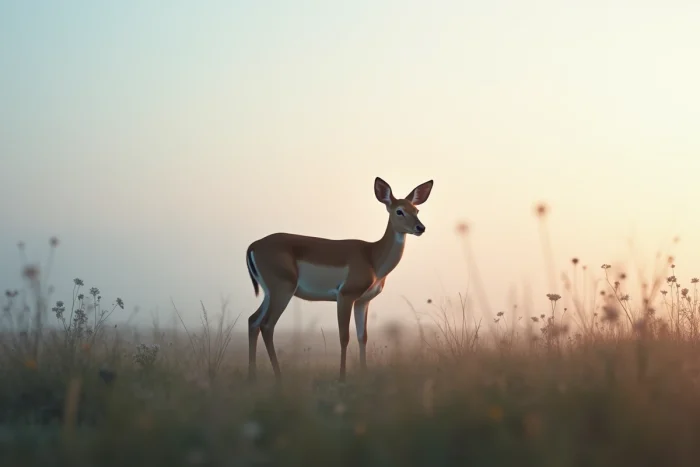
Celtic traditions associate the doe with feminine sovereignty and the passage between worlds. In the Arthurian cycle and Irish tales, the white doe guides the hero to the Otherworld. It is not a passive symbol of sweetness: it opens a threshold, and those who follow it accept a transformation.
In ancient Greece, the doe is the sacred animal of Artemis. It embodies virginity as autonomous power, not as deprivation. Artemis protects wild spaces and childbirth, two domains where the doe serves as a symbolic vector between the domestic and the non-domestic.
Why the doe is not a symbol of fragility
The confusion between sweetness and weakness appears in most mainstream content. The doe possesses sensory acuity superior to that of the stag in certain configurations (detecting predators, protecting the fawn). Its constant vigilance and ability to flee with remarkable precision are a matter of survival skill, not a passive stance.
The sweetness of the doe is an adaptive strategy, not a sentimental quality. We observe that this distinction changes the significance of the symbol: the doe invites operational sensitivity, the kind that captures information before it becomes a threat.
Doe in dreams: structured interpretation framework
Dreams involving a doe fall into recurring configurations, each carrying a distinct symbolic register. Rather than a vague list of “messages,” we recommend cross-referencing the dream context with three axes.
- Stationary doe and direct gaze: a signal of an intuition that the dreamer refuses to listen to. Eye contact with a flight animal indicates a moment of suspension where the unconscious demands attention.
- Moving doe, followed by the dreamer: theme of passage, of transition. Here we find the Celtic motif of the guiding doe. The dreamer is in a phase of change not yet embraced.
- Injured or endangered doe: projection of a vulnerable part of oneself that the dreamer perceives as threatened. This motif often appears during periods of emotional overload or neglect of one’s own needs.
- Doe accompanied by a fawn: a direct link to maternal protection, transmission, or a nascent project that requires care.
Interpretation gains precision when noting the dream environment (dense forest, clearing, road) and the dominant emotion upon waking.
Doe as a totem animal: yin energy and self-compassion
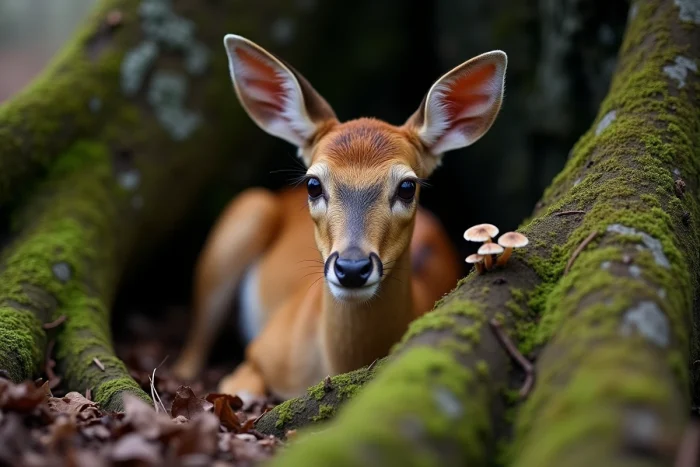
In shamanic and neo-shamanic systems, the doe is classified among totem animals with dominant yin energy. It is associated with the Earth element and the autumn season, a time of withdrawal and inner maturation.
Contemporary psychology aligns with this framework through another path. Therapy protocols based on compassion imagery use “gentle” animal figures to activate emotional regulation. The doe, with its cultural charge of gentleness and non-aggression, serves as a visualization support in certain interventions based on self-compassion imagery.
What the doe concretely asks
If the doe manifests as a guiding animal (in recurring dreams, repeated encounters, or persistent affinity), the message revolves around three axes:
- Reassessing one’s relationship with vulnerability: not to protect oneself more, but to accept sensitivity as a navigation tool
- Slowing down the decision-making pace: the doe does not charge; it observes before acting. The invitation concerns the quality of attention given to situations before reacting
- Restoring a connection with the natural environment: the doe consistently leads back to the forest, the edge, the silence. It is no coincidence that significant encounters occur during moments of solitude in nature
The doe does not carry a single, universal message. Its significance becomes clearer at the intersection of its context of appearance, the tradition in which one chooses to read it, and the emotional state of the one who encounters it. The symbol only exists when activated by a personal situation. It is this activation that transforms an animal observation into a meaningful experience.