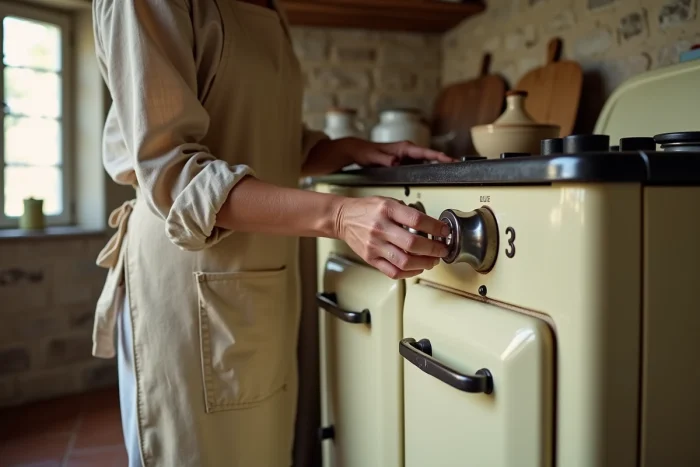
You pull out your old cookbook, and the instruction says “thermostat 3”. The oven displays graduations without degrees. Before risking a failed dish, you need to know what this number actually means, and especially if your oven truly reaches this temperature.
Thermostat 3: the quick conversion rule
The method is straightforward. You multiply the thermostat number by 30 to get the temperature in degrees Celsius. Thermostat 3 corresponds to 90 °C, which places the oven in gentle cooking mode.
This rule works across the entire scale: thermostat 1 gives 30 °C, thermostat 6 gives 180 °C, thermostat 8 gives 240 °C. If the recipe mentions a temperature, you divide by 30 to find the thermostat. To know precisely what temperature corresponds to thermostat 3, this calculation serves as a reference in all cooking manuals.
At 90 °C, we are in the range of slow cooking and keeping warm. This is where you simmer candied fruits, dry tomatoes, or dehydrate herbs. It is not a temperature for searing or browning.
Difference between displayed thermostat and actual oven temperature
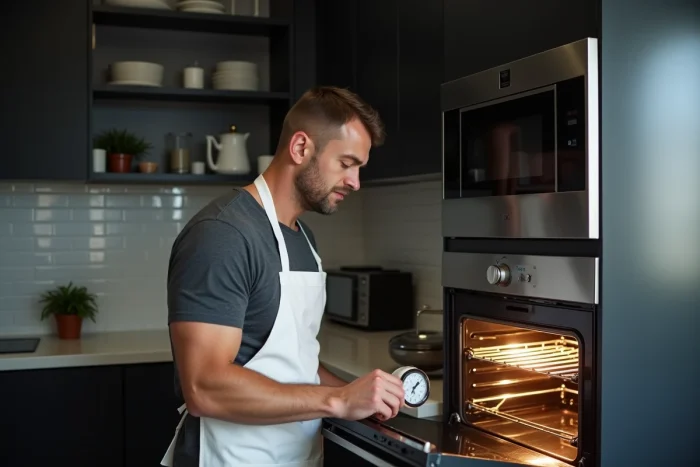
Setting the thermostat to 3 does not guarantee that the cavity reaches exactly 90 °C. On an oven equipped with a mechanical thermostat, a difference of a few degrees is common, even on a well-functioning appliance. In a professional setting, it is considered normal for the difference not to exceed 5 °C between the set point and the temperature measured by a precision thermocouple.
The problem is that many aging domestic ovens exceed this tolerance significantly. A worn door seal, a misadjusted mechanical thermostat after years of service, or simply an insufficient preheating can skew the results.
Why temperature measurement varies by location
The temperature is not uniform in the cavity. Near the walls, radiant heat skews the readings. An oven thermometer with a long probe (about 100 mm), placed in the center of the rack, provides a much more reliable reading than a small dial resting against the glass.
Feedback varies on this point depending on thermometer models, but the principle remains the same: measure in the center of the cavity, away from the heating elements and walls. This is the only way to know if your thermostat 3 actually heats to 90 °C or drifts towards 80 or 100 °C.
Convection oven or static: thermostat 3 does not yield the same result
In a convection oven, a fan circulates hot air throughout the cavity. Cooking is more even, and the temperature felt by the dish is slightly higher than that of a static oven set to the same thermostat.
In practice, the temperature is generally reduced by 10 to 20 °C in convection mode compared to a traditional oven. At thermostat 3:
- In a static oven, the theoretical temperature is 90 °C, suitable for very gentle cooking and long drying
- In convection mode, the effective heat approaches what you would get at a slightly higher thermostat in static mode, so you need to reduce by half a notch or monitor more closely
- On recent ovens with electronic probes, the regulation partly compensates for this difference by continuously adjusting the heating around the set point
Checking the cooking mode before baking avoids unpleasant surprises, especially at low temperatures where a few degrees can change the outcome of a dish simmered for hours.
Recipes and cooking suitable for thermostat 3
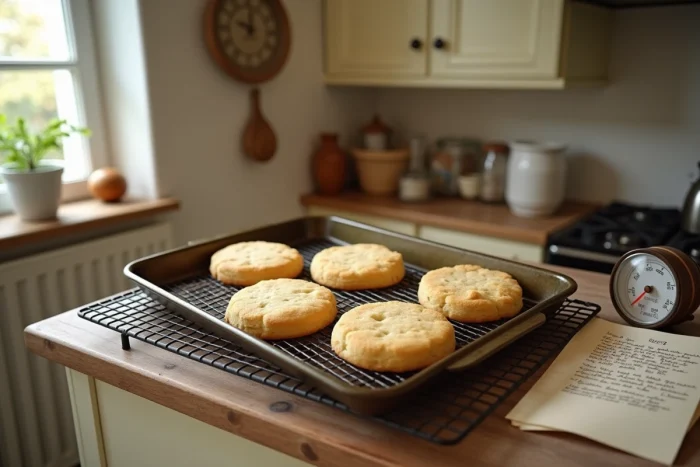
Thermostat 3 is not the most common in cookbooks, but it has specific uses. It is used for preparations that require time and moderate heat without browning.
- Drying tomatoes or mushrooms: oven door slightly open, for several hours, to evaporate water without cooking
- Confiting fruits in a light syrup, where too high a temperature would burst the flesh
- Keeping a cooked dish warm while waiting to serve, without continuing to cook
- Dehydrating herbs to preserve them in jars
For meringues, often mentioned in this temperature range, you typically go towards thermostat 3 to 4 depending on thickness. A thin meringue dries at 90 °C, while a thicker one requires a bit more to cook through without browning.
What does not work at thermostat 3
Any recipe that requires a Maillard reaction (golden crust, gratin, bread) requires at least 150 °C. Baking a quiche or cake at thermostat 3 will yield a doughy and undercooked result. The 90 °C range remains one of patience, not of vigorous cooking.
An oven set to thermostat 3 operates at low temperature, and this zone requires a control thermometer if your appliance does not display degrees. Multiply by 30, check in the center of the cavity, adjust according to the heat mode: these three reflexes are enough to ensure that the number 3 on the dial is no longer a guessing game.