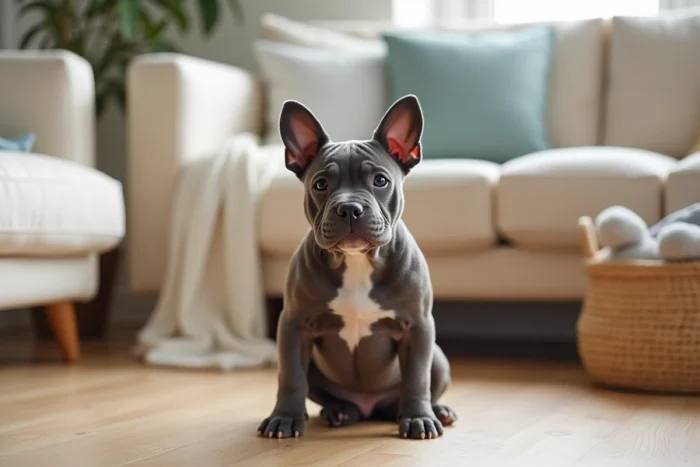
Choosing an American Bully or Exotic Bully puppy is not about comparing two variants of the same breed. The regulatory status, official recognition, and health profile differ in ways that directly impact the budget, administrative procedures, and the dog’s lifespan. This article measures these gaps to establish the criteria that matter before making a purchase.
American Bully vs Exotic Bully: official recognition and regulatory status
| Criterion | American Bully | Exotic Bully |
|---|---|---|
| Canine recognition | Recognized by the ABKC and some national registries | No international canine federation (neither FCI nor AKC) |
| Breed standard | ABKC standard published with defined varieties (Standard, Pocket, XL, Classic) | No unified official standard |
| Declaration at the town hall (France, since January 1, 2026) | Mandatory for the XL variety (decree n°2025-1478) | Mandatory (decree n°2025-1478) |
| Behavioral assessment | Annual, by an approved veterinarian (XL variety) | Annual, by an approved veterinarian |
| Specific insurance | Required for the XL variety | Required |
This table summarizes the administrative gap between the two dogs. The American Bully Standard, Pocket, or Classic escapes the constraints of decree 2025-1478. In contrast, the Exotic Bully and the American Bully XL are subject to the same obligations for declaration, assessment, and insurance since January 1, 2026.
The absence of an official standard for the Exotic Bully has a direct consequence: the morphology varies significantly from one breeder to another. To delve deeper into this point before contacting a breeder, Attitude Canine’s advice details reliable morphological benchmarks for each type.

Health of the Exotic Bully: a risk profile that changes the calculation
The choice between American Bully and Exotic Bully largely hinges on health. The Exotic Bully is predisposed to upper airway obstructive syndrome (known as brachycephalic syndrome), directly linked to the selection of very short muzzles and wide skulls.
This predisposition is not trivial. It results in chronic respiratory difficulties, intolerance to heat and exertion, and recurring veterinary expenses. The American Bully Standard or Classic, with a more proportionate muzzle, presents a significantly less critical respiratory profile.
Health precautions before purchasing an Exotic Bully puppy
- Check that the parents breathe without audible noise at rest and after moderate exertion, a sign that the brachycephalic syndrome is not severe in the lineage.
- Request the results of orthopedic examinations (hip dysplasia, patellar luxation), common in dogs with compact morphology.
- Require a recent veterinary certificate for the puppy, distinct from the simple vaccination booklet, attesting to the absence of visible malformation of the respiratory tract.
- Ensure that the breeder conducts genetic tests on the breeding stock, even if no official standard requires it.
The absence of an official standard makes the breeder’s tests all the more crucial: without a federal framework, the health quality of the puppy relies entirely on the breeder’s selection choices.
Breeding criteria for American Bully and Exotic Bully: what distinguishes a serious breeder
The seriousness of the breeding weighs more heavily for an Exotic Bully than for an American Bully recognized by the ABKC. The reason is mechanical: a published standard imposes limits on selection (proportions, weight, structure), while the Exotic Bully can be produced without any external constraints.
Concrete signals to verify with the breeder
A reliable breeder shows the puppy’s parents on-site, not just in photos. They provide a sales contract specifying the lineage, tests performed, and health guarantees. For the Exotic Bully, ask if the breeder is affiliated with a voluntary registry like the FBKC (French Bully Kennel Club), which offers a monitoring framework even without FCI recognition.
A breeder who refuses to show the parents or their health results poses a major risk, regardless of the breed. For the American Bully, ABKC traceability offers a minimal safety net. For the Exotic, this safety net does not exist.

Real budget for a Bully puppy: beyond the purchase price
The purchase price of a puppy reflects only a fraction of the total cost. Since decree n°2025-1478, owners of Exotic Bully and American Bully XL must budget each year for a behavioral assessment by an approved veterinarian and specific liability insurance.
In addition to these regulatory costs, there are health-related expenses linked to the breed’s profile. Nutrition also represents a significant expense: Pocket or Standard variety Bullies consume less than XLs, but all require kibble suited to their muscle mass and digestive sensitivity.
- Annual regulatory costs (XL and Exotic): veterinary behavioral assessment, mandatory insurance, declaration at the town hall.
- Predictable health costs: respiratory follow-up (especially for Exotic), orthopedic assessment, vaccinations, and antiparasitics.
- Nutrition: high-protein kibble, suited to the dog’s size and physical activity.
The Pocket or Classic variety of the American Bully, not subject to decree 2025-1478, remains the least burdensome option in terms of administrative and financial constraints.
The choice between American Bully and Exotic Bully boils down to a question of traceability. The American Bully benefits from a standard, a registry, and, for varieties other than XL, a lighter regulatory framework. The Exotic Bully offers a distinctive morphology, but its more fragile health profile and the absence of an official standard place the entire responsibility on the quality of the breeder. Checking the health tests of the breeding stock remains the most reliable action before signing.