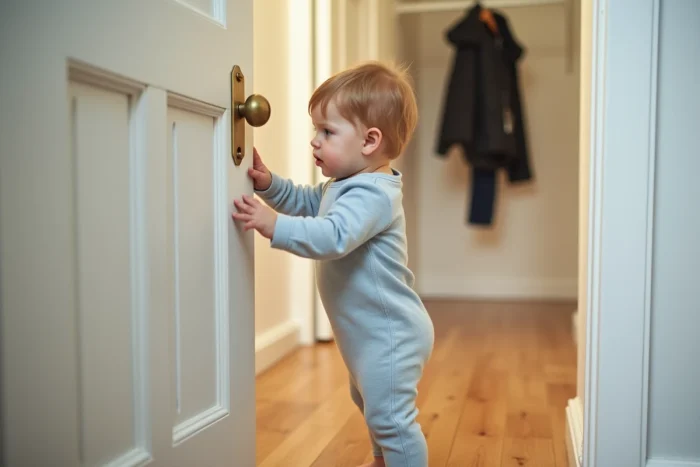
The ability of a child to operate a door handle relies on three simultaneous prerequisites: a sufficient height to reach the handle, pulling strength in the arms, and fine motor coordination between the wrist and fingers. These three conditions rarely come together before the middle of the second year of life.
Fine motor coordination and doors: what happens at the wrist level
Before being able to turn or lower a handle, a child must master wrist rotation combined with a firm grip. This skill falls within the realm of fine motor skills, which progresses in stages from birth to the third year.
By the end of the first year, most babies acquire the pincer grasp. They can pick up small objects, turn the pages of a board book, and manipulate blocks. Voluntary wrist rotation comes later.
Parents wondering when baby starts opening doors: the answer depends on the type of mechanism, but also on the child’s individual development stage. A child who stacks cups and unscrews a lid shows early signs of this ability.
Controlled wrist rotation, combined with sustained pressure on the handle, typically stabilizes between 18 and 24 months. This is the same developmental window that allows the child to use a spoon with greater precision or to turn puzzle pieces to fit them together.
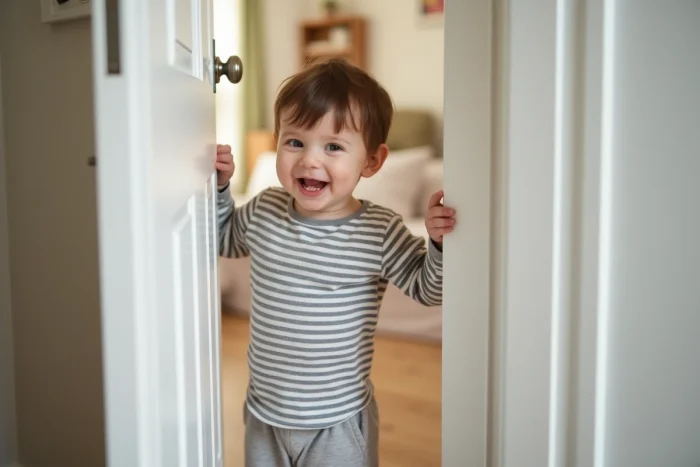
Lever handle or round knob: the type of door makes a difference
Not all door mechanisms present the same difficulty for a toddler. The distinction between a lever handle (horizontal) and a round knob (rotating) is the most underestimated factor by parents securing their homes.
Lever handle
A horizontal handle lowers under the simple weight of the hand. A child reaching for the lever does not need any special gripping strength or complex wrist rotation. Lever handles are the first that children can operate, sometimes as soon as they can stand steadily.
Home safety guides recommend prioritizing the securing of this type of door when the child approaches the 18-24 month range. A plastic handle cover or a high-placed lock is enough to neutralize the risk.
Round knob
The round knob requires a grasping grip and a firm rotation. This combination engages more hand strength and coordination. Most children manage this several months after mastering the lever, often beyond 24 months.
If your home has both types, focus your safety efforts on lever handles first.
Early signs: spotting that baby will soon open doors
Opening a door does not happen overnight. Several observable behaviors signal this acquisition in the weeks leading up to it.
- The child stands on tiptoes to reach high objects (countertop, table, furniture handle). This gesture shows that they are starting to compensate for their height with a voluntary motor strategy.
- They repeatedly open and close drawers, low cabinets, and box lids. This phase of experimenting with cause and effect is characteristic of the 18-24 month period.
- They attempt to operate the handle by hanging on it or hitting it. The intention is present; the technique will come with a few more tries.
- They imitate adults’ gestures on doors: placing their hand on the handle, pulling, pushing. Gestural imitation almost always precedes motor success.
These signs appear alongside other risky exploratory behaviors: climbing on furniture, going up stairs, and climbing the edge of the bed. All are part of the same drive for motor autonomy.
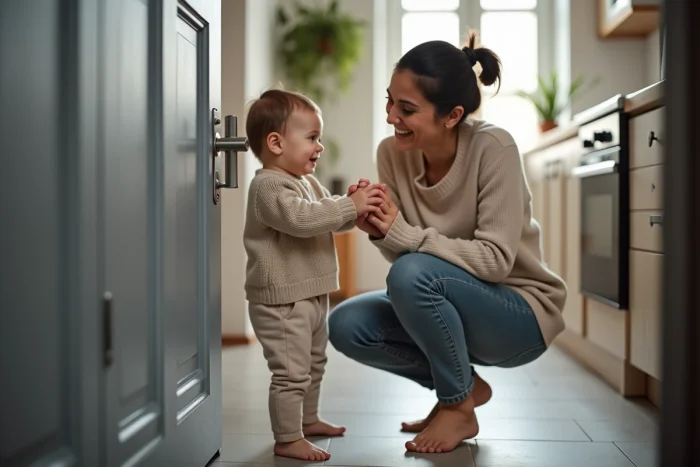
Secure the home before acquisition, not after
The 18-24 month window is identified as a critical time for the risk of wandering outside the home or accessing dangerous rooms (kitchen, bathroom, laundry room). Waiting for the child to successfully open a door to react is akin to securing after the accident.
Three simple measures reduce the risk without transforming the home:
- Install handle covers or lever guards on doors leading outside and to risky rooms. These plastic devices prevent a child from lowering the lever but remain easy for an adult to remove.
- Place a lock or latch high up on the front door, out of reach even when climbing on a low piece of furniture. A standard key lock is not sufficient if the key remains in the door.
- Use foam door stoppers to prevent the risk of finger crushing. The doors that the child manipulates during the learning phase often close with force.
Home arrangements should be anticipated as soon as the child walks independently and steadily, which often corresponds to the period when they begin to explore the mechanisms around them.
Rooms to monitor closely
The bathroom poses the most serious risks (drowning, chemicals, slippery floor). The kitchen follows closely (hot appliances, sharp objects, cleaning products under the sink). These two rooms deserve a secured door at all times from the first signs of the child’s interest in handles.
The pace of each child varies, and some will manage to open their first door well before or well after this 18-24 month window. The most reliable indicator remains direct observation of early signs rather than a fixed age listed in a development chart.