
Saint Antonin water is a natural mineral water sourced from Tarn-et-Garonne, rich in magnesium and sulfates. These two minerals have an osmotic effect in the colon: they attract water into the intestinal lumen, which softens stools and facilitates their evacuation. This mechanism, well documented in adults, explains why this water is frequently mentioned as a remedy for infant constipation.
However, the application to babies raises safety concerns that the popularity of this water does not resolve.
Magnesium, sulfates, and laxative effect: the mechanism to understand above all
Magnesium acts on intestinal peristalsis by stimulating colon motility. Sulfates enhance this effect by increasing water retention in the digestive tract. This is the same principle as that of osmotic laxatives prescribed in pharmacies.
In an adult with fully functioning kidneys, excess minerals are filtered and eliminated without difficulty. In an infant, the situation is different. The kidneys of a baby under twelve months are immature: their filtration capacity remains limited, and a mineral load that is too high can strain them beyond their capabilities.
Parents looking to use Saint Antonin water for baby constipation often draw a comparison with Hépar water, which is also rich in magnesium. The reasoning seems logical, but it overlooks a fundamental point: no published clinical study has evaluated the efficacy or safety of Saint Antonin water in infants.
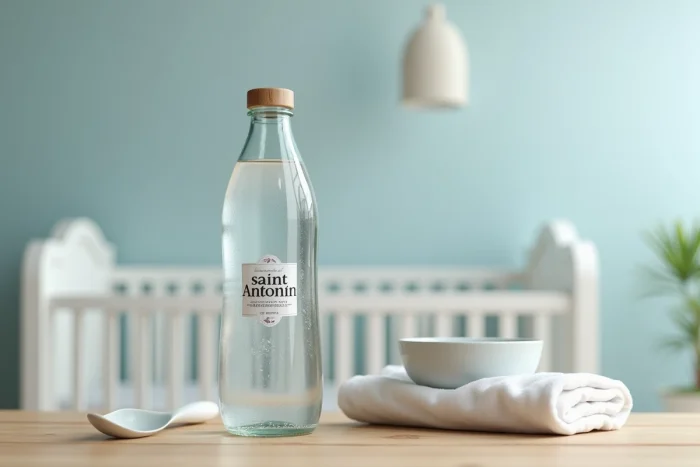
Saint Antonin water in baby bottles: what pediatric recommendations say
WHO recommends low-mineral waters for preparing bottles for children under twelve months. This criterion automatically excludes waters rich in magnesium and sulfates like Saint Antonin or Hépar.
Pediatric societies have recently reaffirmed this position. Their message can be summarized in two points:
- High-mineral waters should not be used to prepare infant bottles, even occasionally.
- For young children (after one year), a short course of magnesium water may be considered, but only on medical advice and in conjunction with prior dietary adjustments.
- Dietary modification remains the first recommended measure before resorting to a laxative water.
Recent communication around Saint Antonin water primarily targets adults suffering from slow transit. No specific mention of infants or young children appears in health articles that cite it among magnesium waters (alongside Hépar or Courmayeur). This absence is not an oversight: it reflects the fact that clinical data is lacking for this age group.
Dry residue and mineralization thresholds: criteria for choosing suitable water for babies
Dry residue measures the total amount of dissolved minerals in one liter of water after evaporation. This is the first criterion to check on the label of a bottle intended for an infant.
For bottle preparation, recommended waters display a low dry residue, generally well below the values presented by magnesium waters. Beyond the overall dry residue, three parameters are particularly important:
- Sodium content, which should remain low to avoid overloading the baby’s immature kidneys.
- Fluoride content, which should be monitored to prevent excessive intake that could affect developing dental enamel.
- Nitrate content, which should be as low as possible in infants.
Waters like Mont Roucous or Evian meet these criteria and are explicitly mentioned as suitable for bottles. Saint Antonin water does not appear on these reference lists due to its mineral profile being too high for daily use in babies.

Infant constipation: measures to prioritize before changing water
Infant constipation is defined by hard stools that are difficult to pass, and not simply by infrequent stools. A breastfed baby may not have stools for several days without being constipated, as long as they remain soft.
Before considering a change in mineral water, several dietary adjustments should be tested. In a diversified infant, increasing fiber intake (prune puree, green vegetables) often yields results within a few days. For a formula-fed baby, a change of infant milk, upon pediatric advice, may be sufficient to restart transit.
Abdominal massages (circular movements in a clockwise direction on the baby’s belly) and leg mobilization in a pedaling motion are simple actions whose effectiveness is recognized by health professionals.
If these measures remain insufficient after several days, a medical consultation is necessary. The pediatrician can assess whether an age-appropriate laxative (such as macrogol) is needed, or if a short course of magnesium water can be attempted under supervision.
The reflex to replace bottle water with a highly mineralized water without medical advice carries a real risk of electrolyte imbalance in an organism whose renal function is not mature. Caution on this subject is not an excessive precaution: it is the official position of health authorities.