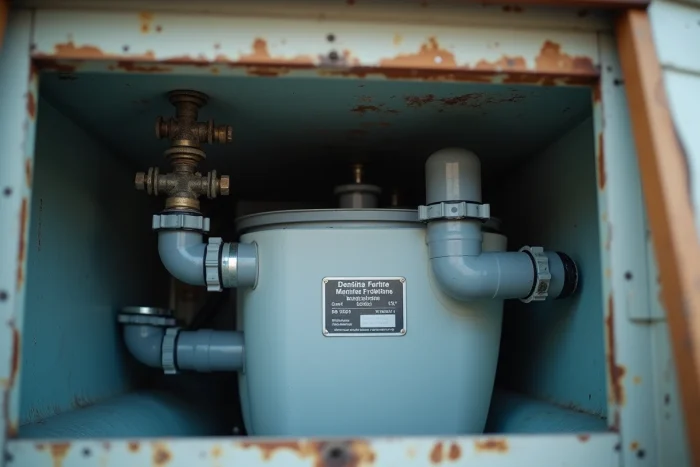
Wastewater on a pleasure boat is divided into two categories that every skipper must distinguish: black water, coming from toilets, and grey water, produced by sinks, showers, and dishwashing. Their treatment, storage, and disposal follow different technical and regulatory logics, and confusing them leads to improperly sized installations.
Holding tank and black water circuit: sizing and technical constraints
The holding tank is the central point of the black water circuit. Its usable capacity determines the sanitary autonomy of the vessel. On a ten-meter liveaboard sailboat, the standard tank provides a few days of autonomy for a crew of two to three people, which requires careful planning of waste disposal stops.
The circuit includes the marine toilet (manual or electric), a reinforced spiral collection pipe, the tank itself, a discharge pump (deck fitting to international standards), and a vent equipped with a charcoal filter. Each connection must be gas and liquid tight, otherwise, hydrogen sulfide emissions will invade the bilge.
We frequently observe installation errors on vents: a diameter that is too small or a right-angle bend is enough to create overpressure in the tank, causing backflows through the toilet. The passage of the discharge pump through the deck (deck fitting) must comply with standardized connections to be compatible with port pumping stations.
To understand precisely where boat waste goes, one must follow this complete circuit: from the toilet bowl to the tank, then from the tank to the shore pumping station or, under certain regulatory conditions, to discharge at sea via an onboard treatment system.
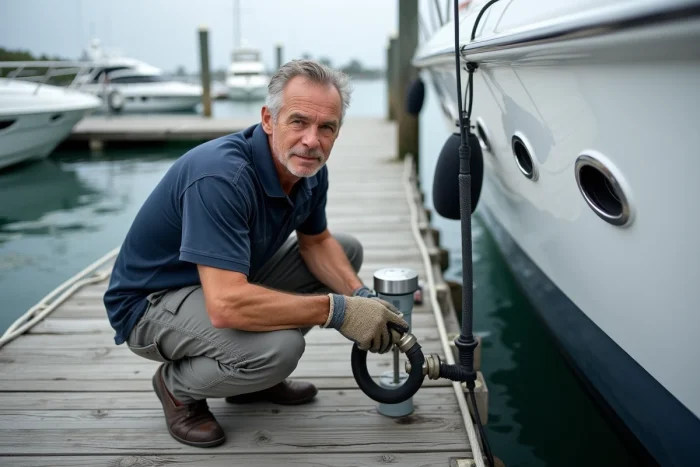
Grey water onboard: an underestimated pollution in marinas
Grey water has long been the neglected aspect of discharge management in pleasure boating. Popular articles focus on toilets, but the residues from dishwashing, soap, shampoo, and cooking grease discharged from sinks and showers represent a significant organic and chemical load.
The report from the Martinique Water Office published in June 2022 highlights that grey water from pleasure boats is now considered a significant source of organic pollution and detergents in port basins. This recognition changes the game: overseas communities are beginning to integrate grey water into their local port discharge management policies, with recommendations for source reduction and onboard treatment.
In practice, reducing the pollutant load of grey water involves three levers:
- Using biodegradable cleaning and hygiene products formulated without phosphates or persistent surfactants to limit the toxicity of discharges even in the event of accidental discharge.
- Installing a grease trap at the kitchen sink outlet, which captures solid food residues and fats before they reach the drainage circuit or the bilge.
- Storing grey water in a dedicated tank when the boat is anchored in a sensitive area (nature reserve, shallow bay), rather than allowing it to flow through the through-hulls.
Biological micro-stations and marine composting toilets: alternatives to the holding tank
The classic holding tank is not the only option. Two alternatives are gaining traction in pleasure boating, each with its own constraints.
Marine composting toilets with separation
The principle is based on the separation of urine and solid waste. Diluted urine can be discharged at sea beyond regulated coastal areas. Solid waste, mixed with a carbon substrate (wood chips, coconut fiber), composts in a ventilated bin. Autonomy depends on the volume of the bin and the number of users, but it often exceeds that of a holding tank of equivalent capacity.
The complete absence of hydraulic connections eliminates the risks of leaks, backflows, and valve corrosion. We recommend this system for crews sailing far from port infrastructure, on long cruises or extended anchorage in remote areas.
Onboard biological treatment micro-stations
These compact devices replicate the principle of a wastewater treatment plant: aerobic treatment degrades organic matter, and the treated effluent can be discharged at sea in compliance with regulatory thresholds. The installation cost and electricity consumption remain high, which limits these systems to vessels over twelve meters equipped with a substantial battery bank or generator.
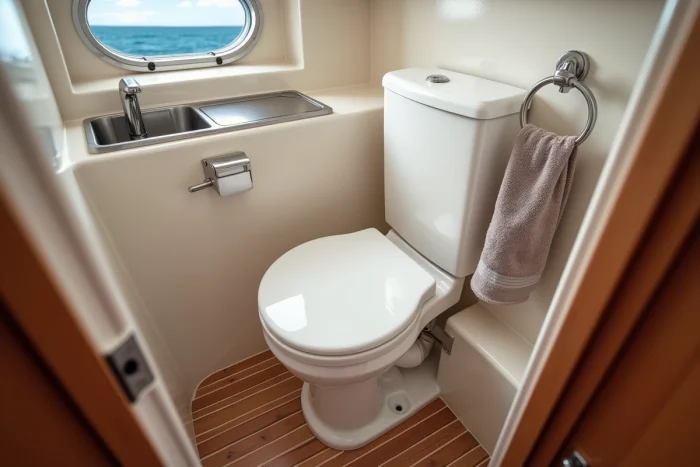
Discharge at the port: why the usage rate of pumping stations remains low
Having a holding tank is not enough if shore discharge is not carried out. The report from the Martinique Water Office notes that a significant portion of boaters continues to discharge at sea or in port basins, even when pumping systems are available at the marina.
The identified reasons are concrete:
- Pumping station opening hours incompatible with the departure or arrival times of boaters, especially early in the morning or on weekends.
- Location of the pumping stations in the port sometimes inaccessible for boats with a deep draft or moored far from the service dock.
- Recurring malfunctions of the pumping equipment, with unreported breakdowns discouraging regular users.
- Complete unawareness of the existence or location of the facilities by passing boaters.
This field observation strongly nuances the theoretical effectiveness of port facilities. Regulatory compliance of a port does not guarantee compliance of user practices. Marina managers who want to reduce contamination of their basins must work on accessibility, maintenance, and signage as much as on the equipment itself.
Wastewater management in pleasure boating remains a topic where the gap between regulation and daily practice is particularly pronounced. Tanks exist, pumping stations do too, but as long as the logistical barriers to their use are not lifted port by port, direct discharges into basins and at anchor will remain a common reality.