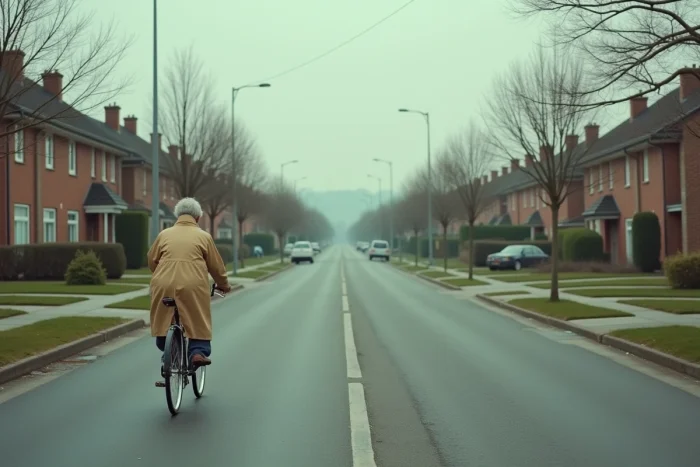
You live in a municipality twenty minutes from a major city, with a recent housing development, a supermarket on the roadside, and fields just behind. Are you in the suburbs or in the peri-urban area? The answer is not obvious, and the confusion between these two terms remains frequent, including in urban planning documents.
Continuity of built environment: the criterion that separates suburbs and peri-urban areas
The clearest distinction lies in a simple visual element: the continuity of the built environment. In the suburbs, buildings follow one another without interruption from the city center. Apartment buildings, houses, and shops form a continuous urban fabric.
In peri-urban areas, the built fabric is fragmented. Housing developments or small hamlets are adjacent to agricultural plots, woods, and wasteland. The peri-urban alternates built spaces and open spaces, whereas the suburbs gradually fill all the gaps.
Geoconfluences, the glossary of ENS Lyon, states it clearly: peri-urban urban sprawl occurs “not in a continuous sheet but in a mosaic.” This mosaic is the fundamental morphological marker. To delve deeper into the distinctions between suburbs and peri-urban areas, this criterion of the built environment remains the most reliable starting point.

Functional dependence on the urban center: what home-to-work journeys reveal
The peri-urban area is not only defined by its landscape. It is also characterized by a strong functional link with a central city, measured by home-to-work commutes. A peri-urban municipality sends a significant portion of its workforce to work in the neighboring urban center while remaining physically separated from it.
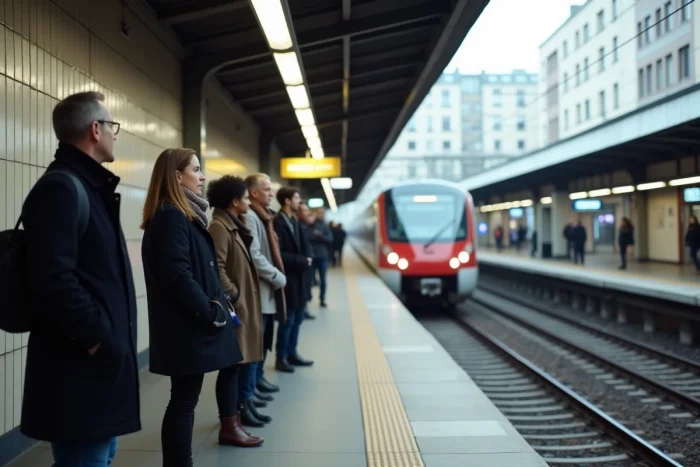
The suburbs, on the other hand, are part of the agglomeration in a statistical sense. Its residents often work in the central city, but the physical proximity changes everything: denser public transport, pedestrian or bicycle access, and public services available on-site.
What the 2020 Insee zoning changes
Since the overhaul of the zoning of urban attraction areas published by Insee in 2020, the category “peri-urban crown” has been replaced by “communes of the crown” of the attraction areas. The thresholds for home-to-work commutes have been revised to incorporate multipolar mobility and telecommuting.
This new classification nuances the classic opposition of city-suburb-peri-urban. It substitutes a gradation of functional dependence on urban centers, more faithful to the reality of current mobilities. A municipality can revolve around two distinct centers, something the old zoning did not capture.
When the suburbs become peri-urban: the blurring of boundaries in Île-de-France
You may have noticed that some municipalities in the small Parisian crown resemble peri-urban villages more than dense suburbs? This phenomenon has a name in recent literature: morphological hybridization between suburbs and peri-urban areas.
Regional studies on Île-de-France, particularly those from the Institut Paris Région on the diversity of built environments in the Île-de-France, show that part of the small crown now adopts built forms close to the peri-urban:
- Scattered housing with individual gardens, without continuity with neighboring areas
- Activity zones on the outskirts of highway interchanges, accessible almost exclusively by car
- Shopping centers on the edge, attracting customers from several municipalities
At the same time, other portions of this same suburb are densifying and “recentralizing,” with programs for collective housing around train stations. The administrative boundary no longer coincides with the morphological reality.
This dual movement makes classic categories insufficient. A municipality administratively attached to the suburbs can function like a peri-urban area (dependence on cars, low densities, few local services), while a well-served peri-urban town by train can resemble a suburban function.
Lifestyles and mobility: the concrete stakes for residents
The distinction between suburbs and peri-urban areas is not just a matter for geographers. It conditions the daily lives of residents on several very concrete levels.
The car, a pivotal variable
In the suburbs, a household can often do without a second vehicle thanks to public transport. In peri-urban areas, dependence on the automobile remains the norm for the majority of trips. The cost of this mobility (fuel, maintenance, insurance) weighs on household budgets and sometimes negates the savings made on land costs.
Access to services and shops
Suburbs generally have local public services (schools, post offices, sports facilities) inherited from decades of dense urbanization. The peri-urban, built more recently and in a more dispersed manner, often suffers from a lack of facilities. Residents turn to peripheral shopping centers or the central city, which reinforces car dependence.
Land and home ownership
Historically, peri-urban areas have attracted households wishing to access ownership of a single-family home, in a context of lower land prices than in the suburbs. This mechanism, fueled by the rise of mortgage credit and homeownership assistance policies, has been the main driver of peri-urbanization since the 1970s.
Peri-urbanization and ecological transition: a planning challenge
The fight against land artificialization places peri-urban spaces at the center of planning debates. Their mosaic-style urbanization consumes more agricultural and natural land per inhabitant than dense suburbs.
Several levers are being considered to evolve these territories:
- Gentle densification of existing peri-urban towns, through parcel division or elevation
- Development of alternative mobilities (cargo bikes, structured carpooling, express bus lines)
- Strengthening local centralities to reduce trips to the urban center
The peri-urban area is not doomed to remain a car-dependent space. Municipalities in the crown that invest in local services and targeted transport links are beginning to change the daily functioning of these territories.
The distinction between suburbs and peri-urban areas remains useful for understanding how French cities have been built. It loses clarity as urban forms hybridize and mobilities diversify. What matters now is less the administrative label than the actual functioning of the territory: who lives there, how people move around, what services are available.