
Varying your menus each week presents a concrete problem that most households face: you end up with the same dishes, you improvise in front of the fridge, and the mental load accumulates. According to a report from Anses published in 2024, people who plan their menus weekly report significantly less stress related to evening meals. The issue goes beyond simple organization: it touches on dietary balance, grocery budgets, and waste.
Rotating by categories of dishes, an underestimated framework for varying your menus
The majority of online advice suggests listing your favorite recipes and then spreading them out over the week. This approach quickly reaches its limits because it relies on a fixed stock of known dishes. You end up rotating among the same fifteen recipes.
A more sustainable method involves thinking in terms of categories of ingredients or cooking methods rather than recipes. You assign a theme to each night of the week: roasted vegetables, legumes, fish, stews, assembled meals. The exact content changes according to the season and available products, but the structure remains stable.
This framework reduces the number of decisions to make. Instead of choosing from thousands of recipes, you only look for a dish that fits the day’s category. Several feedbacks on forums like Reddit confirm that this rotation framework holds up better over time than a fixed schedule. To go further, the myn idee tips on Le Bio du Coin detail how to adapt this principle with fresh and local products.
Seasonal menus: why the vegetable calendar changes everything

Many households buy the same vegetables all year round (tomatoes, zucchini, carrots) and then complain about monotony. The seasonality of products is a natural lever for variation that requires no particular creative effort.
By aligning your menus with seasonal fruits and vegetables, the renewal happens naturally. Squashes and cabbages replace eggplants, leeks take over from green beans. The seasonal vegetable calendar imposes an automatic menu change every two to three months.
The interest goes beyond taste variety. Ademe, in its 2024 edition on household food waste, ranks weekly meal planning among the three most effective practices for reducing food waste at home. Buying seasonal products reinforces this effect: you buy what is abundant, thus cheaper and less likely to end up in the trash.
Building a shopping list based on the seasons
The principle is simple: at the beginning of each month, note four or five seasonal vegetables and two or three seasonal fruits. Build the week’s menus around these products, complementing with grain bases (rice, pasta, semolina) and proteins. The shopping list becomes a reflection of the menu, not the other way around.
This inversion of the process (starting from the product rather than the recipe) opens up combinations that you might not have considered. A parsnip bought out of curiosity can end up as puree, soup, or gratin depending on the cooking method chosen in the rotation grid.
Assembled meals: the trend that simplifies evening cooking
A report from the Cetelem Consumption Observatory dated 2023 highlights a clear rise in assembled meals in French households. The principle: combine simple elements (a grain base, cut vegetables, a protein, a sauce) without following an elaborate recipe.
Bowls, filled wraps, composed plates like mezze, or complete salads fall into this category. Their advantage for weekly variation is direct: by changing just one component, you get a dish perceived as different.
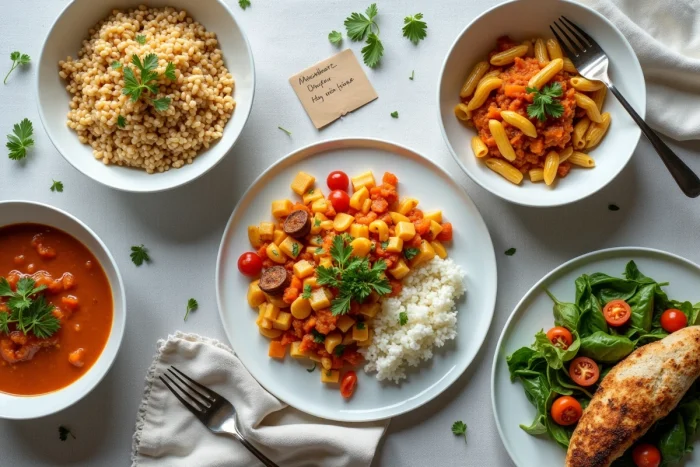
A bowl of rice with roasted vegetables and chicken on Tuesday becomes a bowl of quinoa with chickpeas and raw vegetables on Thursday. Changing one ingredient out of three is enough to refresh the meal. Evening cooking takes about twenty minutes, which corresponds to the time constraint expressed by most active households.
What menu apps bring (and their limits)
Studies published in 2023 in the journal Appetite show that menu planning apps with automatic suggestions reduce the mental load associated with cooking, especially among parents of young children. These tools suggest recipes based on leftovers, dietary preferences, or budget.
Field feedback varies on this point. Some users find that the suggestions lack relevance or propose recipes that are too complex for a weekday evening. Others appreciate the automatic shopping list generation feature. The Fabrique à Menus from Manger Bouger, for example, offers a free planning service, but the proposed recipes do not always take into account the local seasonality of products.
- Apps work well for people looking for occasional inspiration and who lack recipe ideas beyond their usual repertoire.
- They are less suitable for households that buy from local markets or short supply chains, as the suggestions do not always match the products available that day.
- The real time savings depend on the quality of the recipe database and the ability to filter by preparation time, type of diet, or number of people.
Weekend batch cooking: when bulk preparation gets stuck
Batch cooking (preparing several dishes on Sunday for the week) is often presented as the universal solution. In practice, spending two to three hours in the kitchen on the weekend does not suit all households.
A less time-consuming alternative is to prepare only the basics: cook a large quantity of grains, wash and cut vegetables, prepare two different sauces. These elements can then be freely combined each evening based on cravings.
- Cut vegetables can be stored for three to four days in the refrigerator in airtight containers.
- Cooked grains (rice, bulgur, lentils) can be reheated in a few minutes and serve as a base for varied dishes.
- Two different sauces (spicy vinaigrette, herb yogurt sauce, pesto) are enough to transform the same combination of ingredients into two distinct meals.
This modular approach aligns with the logic of assembled meals: you do not cook a complete dish in advance; you prepare building blocks that can be arranged differently each evening. The time spent in the kitchen on the weekend is limited to one hour, and the variety of weekly menus relies on combinations rather than the multiplication of recipes.
Changing your menus each week does not require an infinite repertoire of recipes or hours of planning. A rotation grid by categories, seasonal products, and a few pre-prepared basics cover most needs. The real barrier often remains habit, not a lack of ideas.