A patient who consults three different clinics for a hair transplant often receives three different diagnoses: number of grafts, recommended technique, and usable donor area. This ambiguity is not by chance. Hair transplantation relies as much on the practitioner’s strategy as on their technical skill, and this is precisely what makes the choice of specialist so crucial for the final result.
Donor area and stabilization of alopecia: two points the specialist must address first
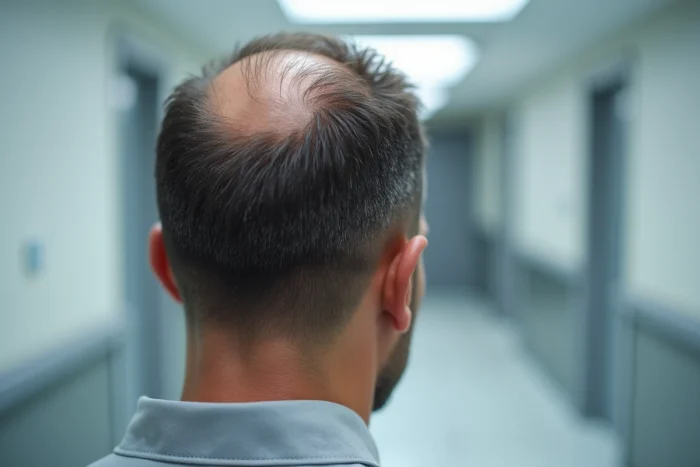
Before discussing FUE technique or the number of grafts, a good practitioner assesses the donor area. Its density, flexibility, and usable surface condition the entire transplant plan. A specialist who announces a graft number during the first consultation without examining the donor area under magnification misses the most critical step.
Recent clinical literature emphasizes a often overlooked point: a transplant performed too early can compromise future interventions. If alopecia is not stabilized, especially in a young patient, hair loss continues after the procedure, and the already depleted donor area can no longer correct the result. One can read the Santé 365 article that details the profiles of practitioners suited to each hair situation.
A rigorous specialist may sometimes suggest postponing the procedure for several months to stabilize hair loss with medical treatment. This is not a commercial hindrance; it is a long-term donor area preservation strategy.

FUE hair transplant: what the technique doesn’t reveal about the practitioner
The majority of clinics today promote the FUE technique. It dominates the market, and for good reason: no linear scar, faster recovery, natural result when well executed. The problem is that FUE has become a marketing argument before being a selection criterion.
What truly distinguishes two FUE practitioners is not the technique itself but how they apply it:
- Is the graft extraction performed by the doctor or delegated to technicians? In some facilities, the surgeon only intervenes for anesthesia and supervision, which affects the quality of extraction.
- Does the practitioner adjust the punch size to the diameter of the patient’s follicles, or do they use a standard size for everyone?
- Does the implantation respect the natural growth angle, follicle by follicle, or are the grafts placed in series without individual adjustment?
The doctor must be able to explain precisely their role at each stage of the procedure. A specialist who is vague about the distribution of tasks between them and their team deserves to be asked the question directly.
Initial consultation: concrete signals of a reliable specialist
The first consultation is the best filter. You learn more about the practitioner there than on any online review page. A few concrete elements allow you to gauge the seriousness of the interlocutor.
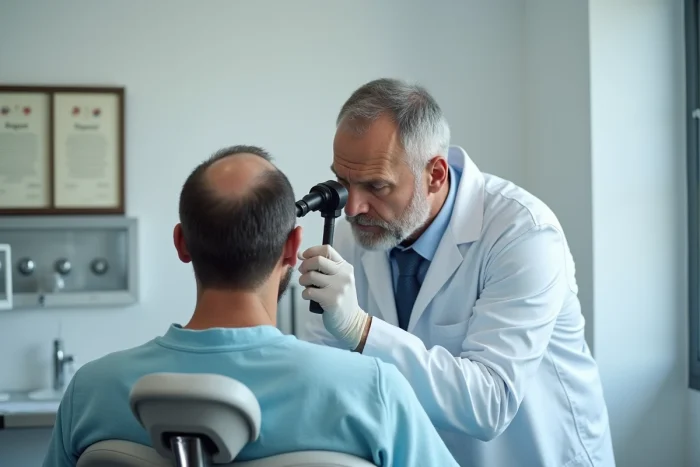
A competent specialist conducts a scalp examination with a magnifying tool (dermoscope or hair camera). They assess the density of the donor area, the miniaturization of the follicles, and the stage of alopecia. Without this examination, any graft estimation is a blind guess.
SOFCPRE (Société Française de Chirurgie Plastique Reconstructrice et Esthétique) reminds us of the obligation for fair patient information. In practice, this means that the doctor must present the limits of the procedure, not just its benefits. A practitioner who never mentions the risks of poor regrowth or the possibility of a touch-up does not adhere to this ethical framework.
What we observe in serious consultations
The doctor shows photos of results on cases similar to yours, not just their best cases. They explain why a certain number of grafts is suitable for your situation and what they will not be able to correct. They propose a reflection period between the consultation and the procedure, in accordance with the recommendations of the Order of Physicians.
Feedback varies on this point, but it is often observed that a clinic that sets the intervention date during the first visit, without allowing this delay, prioritizes patient volume over quality of follow-up.
Results and patient reviews: how to verify what you are shown
Before/after galleries on clinic websites are a communication tool, not scientific proof. The same patient photographed under different lighting or with styled hair can give a misleading impression of the actual result.
To assess the reliability of the displayed results, look for photos taken at different post-operative stages (three months, six months, one year). A result shown only at one year, from a favorable angle, potentially hides insufficient density in the lateral areas or the hairline.
Patient reviews on independent platforms provide more substance than testimonials published on the clinic’s site. Pay attention to comments that describe post-operative follow-up: practitioner callbacks after the procedure, availability for questions in the weeks that follow, protocol in case of unsatisfactory regrowth.
A good indicator remains the practitioner’s ability to connect you with former willing patients. A specialist confident in their results accepts this transparency without difficulty.
The choice of practitioner for a hair transplant is not just about comparing prices or techniques. The rigor of the initial diagnosis, transparency about the procedure, and the quality of post-operative follow-up form a whole that no marketing label can replace. Taking the time to consult two or three specialists before committing remains the most effective precaution.