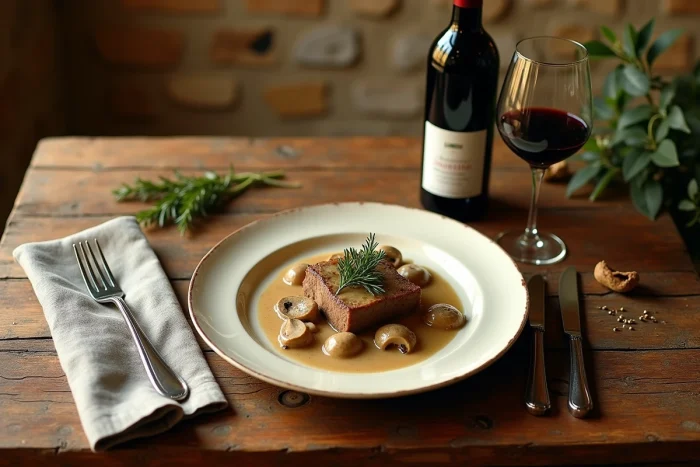
Veal with morels rests on a delicate balance: a white meat with subtle flavor, a creamy sauce rich in umami, and the woody, almost earthy aroma of the mushroom. The red wine chosen to accompany it must respect this structure without overwhelming it. Too tannic, it dries out the sauce. Too fruity, it overshadows the morel. The subject deserves us to go beyond the usual list of recommended appellations to examine what in the wine’s profile truly makes the pairing work.
Aromatic profile of the morel and constraints for red wine
The morel develops aromas of underbrush, roasted hazelnut, and damp earth. These notes are closer to the aromatic register of certain aged wines than to young, fruity cuvées. A red too marked by fresh fruit (cherry, bright raspberry) competes directly with the mushroom instead of enhancing it.
The cream sauce adds a layer of complexity. It coats the palate and reduces the perception of tannins. A wine with tight tannins will seem dry and bitter because the fat of the cream highlights the astringency instead of masking it. To properly understand what to drink with veal and morels, we must start from this double constraint: fine tannins and underbrush-oriented aromatics.
The veal itself, pale meat with a discreet flavor, cannot support a powerful red. It calls for a wine whose alcohol remains moderate and whose body does not mask the delicacy of the protein.
Burgundy Pinot Noir: the classic choice and its limits
Burgundy Pinot Noir remains the most frequent answer to this pairing question. Its light structure, soft tannins, and evolved notes (humus, mushroom, dead leaves from vintages of a few years) make it a logical partner for veal with morels.
The village appellations of the Côte de Beaune (Volnay, Santenay, Monthélie) offer a suitable profile. Their delicate fruitiness fades enough to let the morel express itself, and their crisp acidity structures the pairing against the cream.
The limit is well-known: cost. Good-quality Burgundy reds reach price levels that make the exercise less accessible for an everyday meal. And not all Burgundy Pinot Noirs are suitable. A wine that is too young, too oaky from aging in new barrels, risks imposing vanilla or toasted notes that disrupt the pairing. Favoring a vintage with at least three to four years of bottle age radically changes the result.
Jura and Savoie Reds: underestimated alternatives
Several sommeliers report a growing demand for Jura reds to accompany creamy mushroom dishes. Trousseau and Poulsard present a profile that meets the pairing constraints point by point:
- Low extraction and fine tannins, which avoids any dryness in the mouth against the cream
- A slightly spicy aromatic profile, with notes of underbrush that extend the register of the morel
- A generally moderate alcohol level, compatible with the delicacy of the veal
Trousseau, in particular, brings a slightly more pronounced structure than Poulsard while remaining in an airy register. Its peppery side and mineral finish create an interesting counterpoint to the roundness of the sauce.
On the Savoie side, Mondeuse produces fresh reds with crunchy tannins and aromas of black fruits mixed with spices. This option is rarely mentioned in classic veal-morel pairing guides, even though the grape’s profile is well-suited, provided a low-extraction cuvée is chosen. Field feedback varies on this point: some find Mondeuse too lively for a creamy sauce, while others believe that this liveliness cuts through the fat and refreshes the palate.
Italian Pinot Nero and gentle vinifications: less conventional options
The Gambero Rosso guide (2024 edition) highlights Pinot Nero from Trentino-Alto Adige and Friuli for creamy mushroom dishes. Their fresh, low-tannin profile, with notes of underbrush and red fruits, is reminiscent of Burgundy Pinot Noir in its most airy expression, often at more accessible prices.
This opening towards northern Italian reds with typically French dishes like veal with morels hardly appears in Francophone content. Yet it is a solid option for those seeking a successful pairing without systematically turning to Burgundy.
Beyond geographical origin, the winemaking method is as important as the grape variety. So-called gentle infusion techniques (short macerations, low extraction, gravity work) produce reds with a silky texture and almost imperceptible tannins. A Beaujolais from semi-carbonic vinification, for example, a Morgon or a Fleurie from an artisanal producer, can offer a remarkable pairing thanks to its suppleness and aromas of small spicy fruits.
Selection criteria for a successful pairing
- Soft to melted tannins: exclude any young wine with high extraction
- Tertiary or spicy aromas: underbrush, mushroom, pepper, hazelnut
- Sufficient acidity to cut through the fat of the cream without aggressiveness
- Moderate alcohol, below the threshold of heady wines, to avoid overpowering the veal
- Discreet aging: avoid marked oakiness that masks the morel
Serving temperature and timing: two details that change the pairing
A light red served too cold loses its underbrush aromas and seems thin against the sauce. Served too warm, it develops an alcohol sensation that weighs down the whole. The window is around the coolness of a cellar, neither chilled nor room temperature.
Decanting is divisive. On a Pinot Noir of a few years, a short aeration (about twenty minutes) can release the evolved notes without dissipating the finesse. On a Trousseau or Poulsard, prolonged decanting risks tiring an already fragile wine. It’s better to open the bottle half an hour before and serve directly.
The pairing also plays out in the timing of the meal. The morel in creamy sauce gains intensity as it cools slightly and the flavors concentrate. The wine must be able to hold this increase in power without seeming overwhelmed after twenty minutes in the glass.
Veal with morels does not require a great wine, but a just wine. A Jura Trousseau, an Italian Pinot Nero from Alto Adige, or a few-year-old Burgundy village fulfills this role with more accuracy than a prestigious but too young or too extracted red. The pairing is built on restraint, not on power.