
Choosing kitchen and table equipment involves balancing materials with very different properties, formats that dictate daily use, and regulations that evolve regarding substances in contact with food. This guide outlines measurable criteria for comparing pans, pots, knives, and tableware before any purchase.
Cooking Coatings and PFAS Regulations: What the Law Really Changes
Law No. 2025-188 of February 27, 2025, introduced restrictions on certain PFAS in France. Many product sheets now display the mention “PFAS-free.” This wording is not defined by the law itself: it is a commercial claim, not a regulatory obligation.
According to an analysis by Kohen Avocats, an inaccurate claim about a coating may fall under misleading commercial practices. Requesting the exact composition of the coating is more reliable than a self-proclaimed label. A serious manufacturer specifies the type of polymer used (sol-gel ceramic, enamel, PTFE without PFOA) rather than a simple marketing negation.
This point does not mean that all non-stick pans are banned. The law targets specific substances, not non-stick technology as a whole. By browsing the equipment universe of La Cigale et la Fourchette, it is evident that current ranges increasingly detail their technical specifications, a sign that the market is gradually integrating this transparency requirement.
Another often-overlooked distinction: European regulations are also evolving regarding food contact packaging. This evolution concerns packaging (films, trays), not the coatings of pans or pots. Confusing the two leads to poorly informed choices.
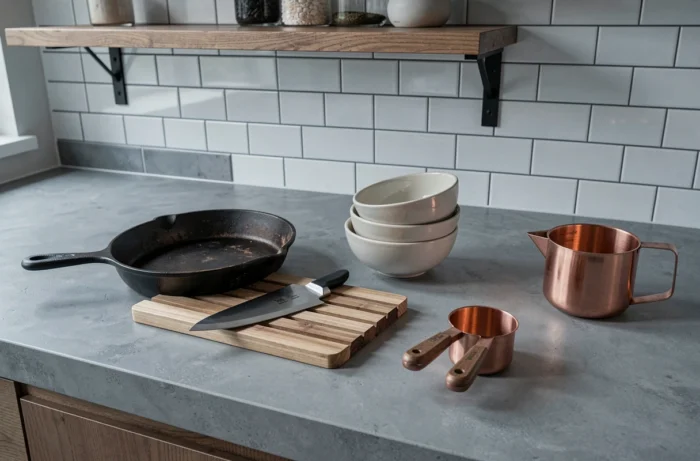
Materials of Cooking Utensils: Comparison Table
The material determines thermal conductivity, lifespan, and compatibility with cooking surfaces. Here is a comparison of the four most common materials for pans and pots.
| Material | Thermal Conductivity | Induction Compatibility | Maintenance | Estimated Lifespan |
|---|---|---|---|---|
| Stainless Steel 18/10 | Medium | Yes (if ferritic base) | Easy, dishwasher safe | Very long |
| Cast Iron | Slow but even | Yes | Immediate drying, regular seasoning | Several decades |
| Aluminum (coated) | High | No (unless steel base) | Gentle washing, no metal utensils | Several years depending on coating |
| Copper | Very high | No | Frequent polishing | Long if well maintained |
Stainless steel and cast iron dominate in durability, while coated aluminum and copper excel in thermal reactivity. The choice depends on the type of cooking practiced: searing meat requires rapid temperature increase (aluminum, copper), while simmering a dish for hours favors cast iron.
The Special Case of Wooden Utensils
Wood (beech, olive, bamboo) remains the reference material for spatulas, spoons, and cutting boards. Wood does not scratch non-stick coatings and does not conduct heat to the hand. Its maintenance requires hand washing and quick drying to prevent cracking. Occasional oiling with a neutral food oil extends its durability.
Kitchen Knives: Selection Criteria by Use
A complete knife block is not always necessary. Three blades cover most daily tasks:
- A chef’s knife (versatile blade size) for chopping, dicing, and slicing vegetables, meats, and herbs. It is the central tool in any kitchen.
- A paring knife (small short blade) for peeling, trimming, and making precise cuts on small foods.
- A bread knife (long serrated blade) for slicing without crushing the crumb, also usable on tomatoes and certain thick-skinned fruits.
Stainless steel resists corrosion but sharpens less finely than carbon steel. Carbon steel, on the other hand, takes a very fine edge but rusts without immediate drying. The choice often boils down to maintenance: those who dry their knives after each use benefit from carbon, while others prefer stainless steel.
The ergonomics of the handle matter as much as the blade. A handle that is too heavy tires the wrist during long cuts. Testing the grip before purchase, when possible, avoids unpleasant surprises.

Tableware and Table Arts: Porcelain, Stoneware, or Earthenware
The choice of tableware is based on three parameters: shock resistance, dishwasher compatibility, and visual appeal at the table.
Porcelain withstands temperature variations and is microwave-safe. Its fineness makes it elegant for both everyday use and entertaining. Stoneware, thicker and more rustic, slightly absorbs moisture if the glaze has micro-cracks. Earthenware, often the least expensive, scratches and chips more quickly.
For functional table equipment, it is better to have a consistent service in porcelain or glazed stoneware rather than a mix of mismatched pieces with uneven resistances. A coherent service simplifies the replacement of broken pieces.
Often Underestimated Table Accessories
Trivets, placemats, and serving tongs protect the table and streamline the meal. A cork or wooden trivet absorbs heat better than a metal model, which transfers it directly to the tray.
The choice of kitchen and table equipment relies on verifiable technical data: coating composition, type of steel, nature of the glaze. Comparing these criteria material by material remains the safest method to avoid purchases dictated solely by marketing.