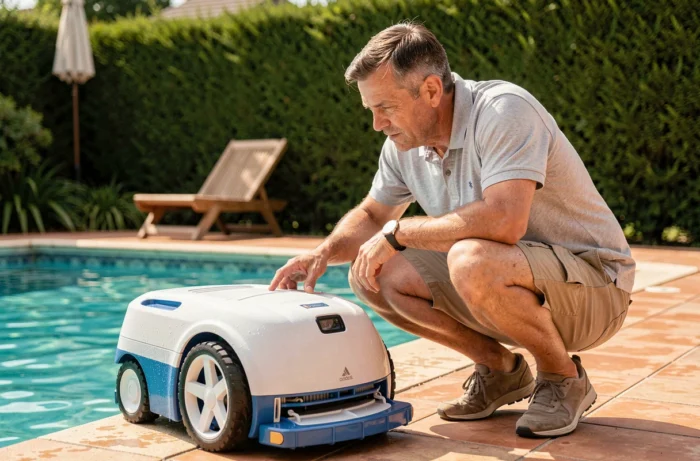
A pool robot may advertise 150 minutes of runtime and an impressive suction rate on its spec sheet. Put it in a freeform pool with Roman steps, and by the end of the cycle, a strip of fine sand is still stuck along the pool edge.
The floor is clean, the walls are only half-brushed, and the waterline is untouched. This gap between the promise and the actual result is the real issue when choosing a pool robot that suits your pool.
The real cost of a cleaning cycle: what the spec sheet doesn’t tell you
Comparing two pool robots based only on their power rating in watts or runtime is like judging a household vacuum cleaner by how noisy it is. The criterion that matters is what’s left on the pool floor after a full cycle.
To assess this, run your hand over the floor and walls once the robot is out of the water. Grains of sand, residual algae in the corners, and debris trapped in the steps give you a far more reliable verdict than a suction rate measured in liters per minute.
Rated runtime, often measured in eco mode on a flat floor, hides an inconvenient fact: in wall and waterline mode, the cycle time can double. A robot that lasts two hours cleaning the floor alone may not have enough battery to cover all the surfaces in a medium-sized pool. You may end up running two cycles, which increases the actual cleaning time and wears out the battery faster.
To evaluate a pool robot’s performance, it helps to keep track over a few weeks of how many cycles are needed, how often you have to finish the job manually with a skimmer net, and how long it takes before you can swim. This usage log reveals the real cost of a completed clean, well beyond the purchase price.
Suction rate and filtration fineness: two figures to consider together
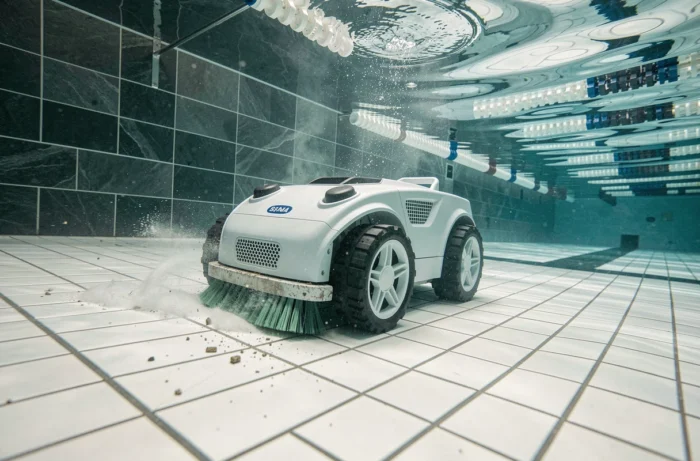
The suction rate, expressed in liters per minute, indicates how much water the robot circulates. A high rate draws in more debris, but without suitable filtration, fine particles pass back into the pool.
Filtration fineness, measured in microns, determines the size of the impurities the filter captures. A very fine filter improves water clarity, but a tightly meshed filter clogs faster and reduces the effective flow rate during the cycle. Some manufacturers supply two types of filters (one standard, one fine) with different usage recommendations depending on the amount of debris.
Checking the manufacturer’s recommendations for choosing a filter in different situations (after a storm, during peak pollen season, or for routine maintenance) helps prevent the robot from operating with reduced flow. The micron rating alone isn’t enough: it’s the combination of flow rate and filtration that makes the difference in a real pool.
What to look for in the filter basket
Emptying the filter basket after a cycle can tell you a lot. If it’s three-quarters full, the robot was likely working at a reduced flow rate toward the end of the clean. The areas covered last will therefore be less thoroughly cleaned.
If your pool is surrounded by trees, skimming out larger debris (leaves, twigs) beforehand will help the cycle run more effectively and protect the robot’s filtration system.
Cleaning coverage based on pool shape
Advertised coverage (floor, walls, waterline) doesn’t translate the same way in an eight-meter rectangular pool as it does in a freeform pool with a submerged ledge. Robots with random navigation will statistically cover the entire surface of a simple pool in one cycle. In a complex pool, they may leave areas untouched, particularly rounded corners and steps.
Robots with mapping-based navigation detect obstacles and adjust their route, reducing the number of missed areas. But this technology doesn’t guarantee perfect results: an additional waterline-cleaning feature, for example, may prove useless if the robot can’t stay at the waterline in a pool with curved walls.
- Rectangular pool with a flat floor: most electric robots cover the floor and walls in one cycle, including entry-level models.
- Freeform pool or one with steps: choose a robot with smart navigation, and check that the manufacturer explicitly lists compatibility with this type of layout.
- Above-ground pool with flexible walls: lightweight cordless robots are often the only compatible option, but their suction power is limited when it comes to fine particles.
- Large pool (over ten meters): a corded robot with an internal motor pump offers greater flow and endurance than battery-powered models.
Battery, recharging, and durability: the hidden cost of a cordless pool robot
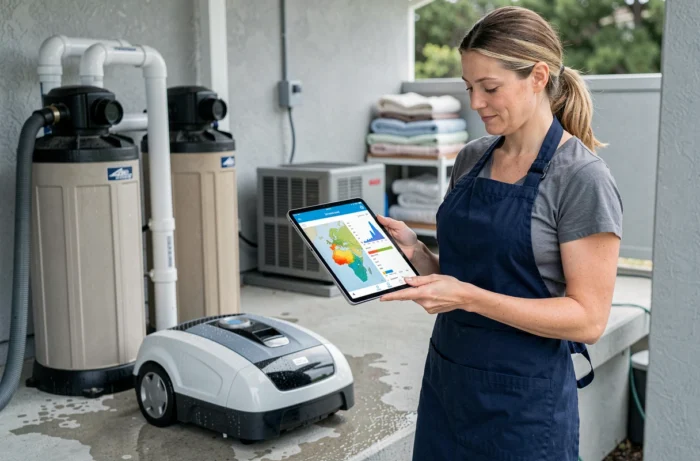
Switching to a cordless pool robot makes it easier to put the robot in the water and eliminates the cable that can get tangled around the ladder. The trade-off is that the battery becomes the main wear item, and replacing it can account for a significant share of the original purchase price.
The runtime shown on the spec sheet often applies to the least power-hungry mode. In real-world use, with wall brushing and increased suction, operating time drops considerably. In peak season, a pool that needs several cycles a week puts the battery through several hundred charge cycles a year.
Availability of replacement parts
Before buying, check that the manufacturer sells replacement batteries as spare parts and can deliver them within a reasonable timeframe. A high-performance robot whose battery is no longer available after three years becomes electronic waste.
Brushes, filters, and tracks are other consumables to factor in. A robot’s annual maintenance costs include these parts, not just the electricity used for recharging.
Corded or cordless electric pool robot: choose based on your pool
The choice between corded and cordless isn’t just a matter of convenience. A low-voltage corded electric robot runs continuously without battery constraints, maintaining a steady suction rate from the start to the end of the cycle. For large in-ground pools, it’s often the most effective choice for coverage and consistency.
Cordless models are better suited to smaller pools or layouts where the cable is a real problem (a central ladder, an L-shaped pool). But limited runtime in full-cleaning mode may mean you have to run a second cycle to finish the walls, partly negating the convenience.
Rather than comparing spec sheets side by side, testing the robot in your own pool during the trial period (if the retailer offers one) is still the most reliable approach. Watts and liters per minute only mean something when considered in relation to the square footage of your pool walls and the kilos of fallen leaves in your garden.