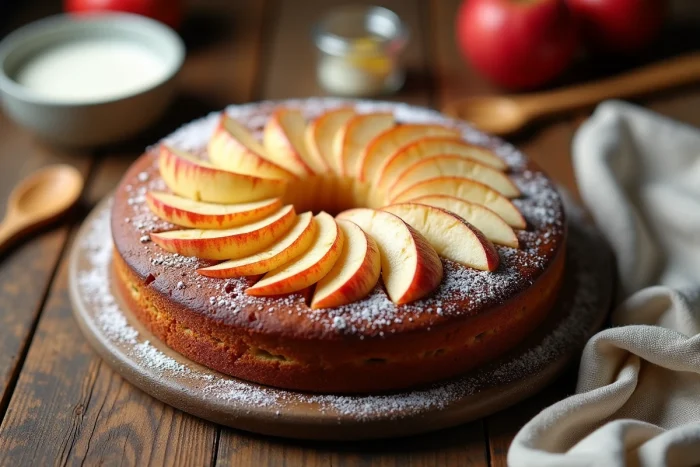
The apple yogurt cake version by Cyril Lignac relies on a precise balance between the hydration of the batter and the fruit’s integrity during baking. Two parameters that most mainstream recipes treat as secondary, while they determine the difference between a compact, waterlogged crumb and an airy result where the apple retains its structure.
Choosing the apple and its impact on batter hydration
The variety of apple significantly alters the final texture of the cake. A soft-fleshed apple (Gala, very ripe Fuji) releases too much water during baking, which makes the crumb around the pieces soggy. We recommend apples that hold up well during baking, such as Pink Lady or slightly unripe Golden, two varieties that Cyril Lignac favors in his shows on M6.
The Pink Lady retains a slight crunch and an acidity that contrasts with the sweetness of the batter. The slightly unripe Golden, more neutral, melts gently without releasing excess juice. In both cases, cutting the quarters into half-centimeter slices allows for even cooking without creating moist pockets.
This approach to the Cyril Lignac apple yogurt cake stands out for the attention paid to the fruit as much as to the batter, a reflex of a professional pastry chef rarely passed on in simplified versions.
Weighing the yogurt in grams rather than relying on the pot
The yogurt pot as a unit of measurement remains the founding principle of this recipe. The problem is that individual yogurt containers vary in the French market. Some pots are 100 g, others 125 g, and still others 140 g for the whipped versions. The difference seems small, but it alters the ratio between dry and liquid ingredients.
Several blogs by professional pastry chefs revisiting Cyril Lignac’s recipes now recommend weighing the yogurt, aiming for about 125 g for a standard pot. This precision avoids two common pitfalls:
- An excess of yogurt that makes the batter too wet and prolongs the baking time, risking a golden top but a still raw center
- A deficiency of yogurt that dries out the crumb and loses the characteristic softness of this type of cake
- An imbalance between the acidity of the yogurt and the sugar, which alters the final taste without clearly identifying the cause
A kitchen scale solves the problem in seconds. The rest of the measurements (flour, sugar, oil) can continue to use the pot as a measuring cup, provided that this pot corresponds to the reference capacity.
Neutral oil and lightness: a detail that changes the result
The classic yogurt cake recipe calls for sunflower oil. Cyril Lignac adheres to this principle of liquid fat (no butter, no margarine), but the choice of oil deserves consideration.
Comparative tests published by 750g show a growing preference for lighter neutral oils, such as grapeseed oil. Feedback from amateur cooks points to a better perception of lightness in the mouth and a clearer enhancement of the apple’s flavor. Sunflower oil works, but it leaves a more noticeable greasy film on the palate.
Grapeseed oil has a high smoke point, making it perfectly suitable for oven cooking. It does not interfere with the fruit’s aromas or with the vanilla that is often added to the batter.
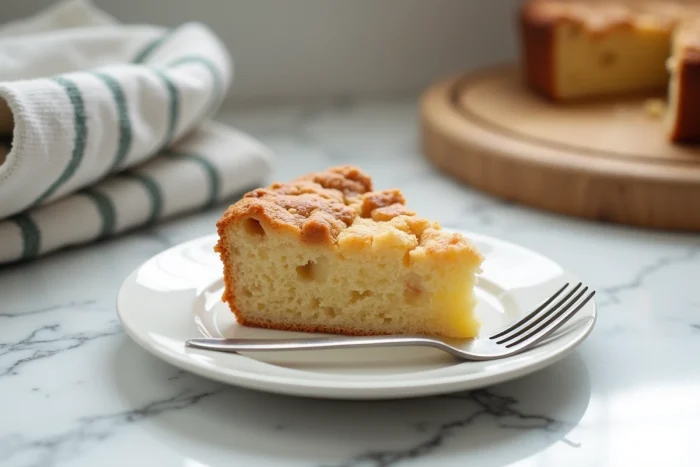
One-bowl technique and order of incorporation
Preparing this cake with a single bowl is not a marketing argument. It is a method that limits gluten development in the flour, provided the order of incorporation is respected.
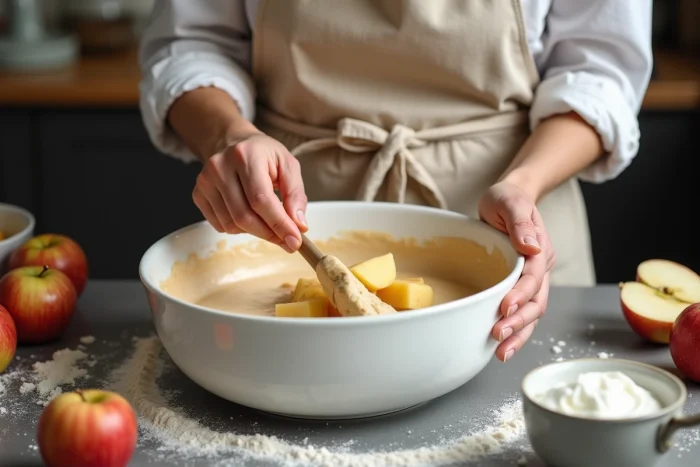
Liquids first, solids next. Yogurt, eggs, sugar, and oil are mixed in the bowl until a smooth texture is achieved. The sifted flour with baking powder is added last, mixing just enough for the powder to disappear. Overmixing at this stage activates the gluten and gives an elastic crumb instead of a tender crumb.
The apples are incorporated in two ways:
- A portion of the slices folded directly into the batter, to create pockets of fruit inside the cake
- The rest arranged in a rosette or in lines on top, for visual appeal and slight caramelization on the surface
- A dusting of brown sugar sprinkled over the top apples just before baking, which forms a thin, golden crust
Baking the apple yogurt cake: temperature and visual cues
Baking is done at preheated oven at 180 °C in convection mode. The duration depends on the mold: a loaf pan extends the baking time compared to a wider, shallower round pan.
The reliable indicator remains the knife blade inserted in the center. It should come out with a few moist crumbs attached, not liquid batter. Removing the cake at this precise moment allows it to finish cooking through thermal inertia outside the oven, without drying out.
A common trap is opening the oven door during the first twenty minutes. The yogurt cake rises thanks to the baking powder, which reacts to heat. A thermal shock at this moment causes the batter to collapse irreversibly. It is better to monitor through the glass and only open at the end of baking for the knife test.
The cake is unmolded after resting for about ten minutes in the mold, on a rack. This time allows residual steam to escape without condensing at the bottom and softening the base of the cake. The texture reaches its best balance at room temperature, one to two hours after coming out of the oven.