
The question of whether a single woman can live alone traverses religious traditions from very different angles. Between Islamic law, Catholic teaching, and Protestant practice, the answers vary according to the texts referenced, the role assigned to the family, and the distinction between cultural norms and theological prescriptions. This article compares the positions of three major traditions on this specific subject.
Single woman living alone: compared positions according to religious traditions
| Tradition | Dominant Position | Main Condition | Role of the Family |
|---|---|---|---|
| Islam (contemporary majority opinion) | Permitted under conditions | Safety of the person | Consultative (wali), not systematically decisive |
| Catholicism | No doctrinal prohibition | Respect for personal morality | No legal family obligation |
| Protestantism | Individual freedom | Personal responsibility before God | No formal guardianship |
This table highlights a structural gap. In Islam, the discussion focuses on the legal framework (fiqh) and the notion of guardianship. In Christianity, whether Catholic or Protestant, no canonical text prohibits a woman from residing alone.
The question that determines living alone as a single woman in the Islamic context is therefore not a single verdict, but a set of conditions related to safety, family context, and the legal school consulted.
Islamic fiqh and autonomous residence: what the texts really say
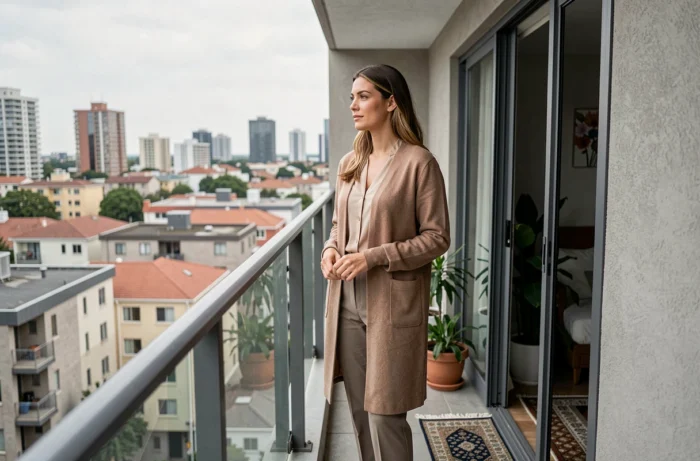
Contemporary opinions clearly distinguish the independent residence of a single woman from legally framed situations such as the period of iddah (waiting period after a divorce or death). The rules of iddah do not apply to a never-married single woman, and confusing them leads to an erroneous religious conclusion, as highlighted by an analysis published by Utrujj in September 2026.
Zakariyya al-Ansari, a jurist of the Shafi’i school, formulated a frequently cited opinion: an adult and rational woman can reside wherever she wishes, provided she does not fear for her safety. This position is echoed by several contemporary fatwa platforms.
The divergence among scholars is less about the principle than about the role of the wali (guardian). Some consider that parental permission remains desirable, while others argue that the wali’s consent pertains to marriage and not to the choice of residence. The parameters guiding the opinion are concrete:
- The safety of the neighborhood and housing, a criterion consistently mentioned in the consulted fatwas
- The absence of a fitna situation (perceived moral risk), a notion whose appreciation varies greatly depending on cultural contexts
- The relationship with parents, which falls under birr al-walidayn (filial piety), a moral obligation distinct from a legal prohibition on leaving the home
The most frequent recommendation remains to prioritize family proximity, without this preference reaching the status of formal obligation (wajib). The nuance is decisive: recommended (mustahabb) and obligatory (wajib) do not have the same status in Islamic law.
Cultural norm or religious prescription: where is the boundary?
The blind spot of the debate lies in the confusion between social custom and theological rule. Several testimonies from Muslim women, relayed on community forums, describe family pressure presented as religious when it actually stems from a local cultural tradition.
This confusion is not unique to Islam. In some Mediterranean Catholic communities, a single woman leaving her parental home historically elicited the same disapproval, without any basis in canon law. Social pressure often cloaks itself in religious vocabulary without having legal legitimacy.
Utrujj’s analysis emphasizes that the religious debate does not sufficiently cover the social and professional constraints experienced by some Muslim women. A job change, studies in another city, a difficult family context: these realities shift the question from a purely legal terrain to that of practical necessity (darura), a concept recognized in fiqh.
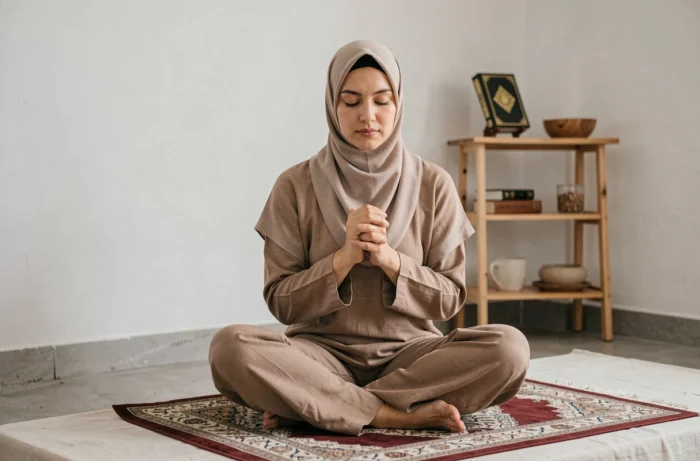
Islam and female autonomy: the weight of context in religious opinion
One element stands out from all the consulted sources: religious opinion in Islam heavily depends on the individual context. A fatwa issued to a woman living in a safe environment, with her own income and maintaining good relations with her family, will not be formulated in the same way as one addressed to a person in a vulnerable situation.
This casuistic approach distinguishes fiqh from a binary halal/haram reading. Contemporary fatwa platforms emphasize case-by-case examination, making any generalization risky.
In contrast, in Christian traditions, the absence of a legal framework equivalent to fiqh leaves the decision entirely to individual conscience. Neither the catechism of the Catholic Church nor Protestant confessions of faith address the residence of a single woman as a moral question.
- In Islam, permissibility is conditional: it depends on safety, family context, and the legal school
- In Catholicism, no canonical norm governs the residence of an unmarried person
- In Protestantism, the principle of the universal priesthood places responsibility on the individual, without institutional mediation on this subject
The real divide does not separate religions from each other, but distinguishes religious legal norms from local customs. A woman questioning the permissibility of her choice would benefit from identifying whether the objection she encounters comes from a specific text or from a social habit transmitted as religious evidence. This distinction, simple in theory, remains difficult to establish when the pressure comes from close relatives.